
|
|||
 |
 |
 |
 |
|
|
 |
 |
|
|
|
|
Born: 1902 in Augsburg. Father’s occupation: businessman. Flat: Prinzregentenstraße.
Marie’s parents were Max Bach (b. 1859 in Altenstadt on Iller) and Mathilde, née Frankfurter (b. 1873 in Stuttgart). In Augsburg, Max Bach was a wholesaler of skins. The couple had four children: Johanna, Fritz, Albert and Marie. Their mother died in Tübingen in 1938, their father at a Jewish hospital in Munich in 1940.
Marie attended Maria-Theresia-School from 1913 to 1920 or 1921, at first in classes 1–6 of the “secondary school for girls”, then for another year or two at the “school for women”.
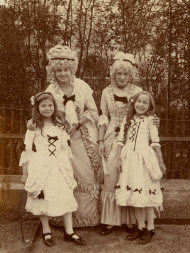
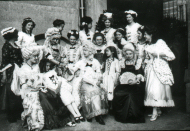
On April 23, 1914, a celebration took place, after which the girls’ parents were invited to visit the new building of the Maria-Theresia-School on Gutenbergstraße, which had just been completed. On this occasion Ernst Johann Groth’s play Madame Breitkopf. Dramatisches Kulturbild aus dem deutschen Frauenleben der Rokokozeit was performed (“Madame Breitkopf: A dramatic picture from German women’s culture and life at the Rococo period”). Marie played the role of “Dorchen”, a daughter of “Madame Breitkopf” (cf. Goethe, Dichtung und Wahrheit, Part II, Book 8).
In 1918, Marie celebrated her “confirmation” in Augsburg, together with her former schoolmate Selma Cohen (Bat Mitzvah: the feast of religious maturity for Jewish girls; it can be celebrated individually on the Sabbath after a girl’s 12th birthday, but in Augsburg it was held annually or even after longer intervals for several age groups together, similar to the Protestant confirmation).
After finishing school, Marie worked as a home economics teacher. She went to Switzerland in 1932, then to Paris and in 1940 was interned at Camp de Gurs, in the Southwest of France, as well as Else Einstein. 2364 women from Paris and its surrounding area arrived at the camp on May 23, 1940, among them many
Jews. They were single women—or married women without children—who had the German nationality. That is why they were automatically regarded as suspect, especially with the war between Germany and France beginning to be fought, and therefore interned. Thereafter, about 7500 Jews from Baden and the Saar-Palatinate were deported to Gurs on October 22, 1940 (among them another former student of Maria-Theresia-School, Rosa Lieblich). The police of the Vichy regime continued sending to this camp Jews who had been apprehended in France.
Marie felt that she had to help the rabbi at the camp. When relatives tried to free her with money, she is said to have refused to leave the camp. Marie’s niece Hanna Lantz, née Hannelore Bach, wrote to Eleonore Philipp from Taylor, Michigan, on December 28, 1994 (in reasonably good German despite a period of emigration that had lasted almost 50 years): “My aunt Marie Bach—my father’s youngest sister—lived and worked in Paris. She was taken to the Gurs Concentration Camp. My aunt Lisbeth (who married my father’s younger brothter, Albert, and lives with him in Israel) had given money to someone at the camp. Aunt Marie, however, said that she could not leave the camp’s rabbi. She was always eager to help him. She was very religious. Later on, she was taken to Terezin and murdered by gas.”
Instead of Terezin (“Theresienstadt”) it is more likely to have been Auschwitz. In 1942 and 1943 the Jewish prisoners at Gurs were deported to Auschwitz and other extermination camps in Poland via the transit camp at Drancy (near Paris). On August 10, 1942, such a transport went from Drancy to Auschwitz. A woman called Marie Bach is on the list of those deported—presumably being identical with
the Augsburg citizen, even though the date of birth and birthplace do not exactly correspond with the Augsburg documents.
Hanna Schramm, who was interned at Gurs from June 1940 to November 1941, reports, in her reminiscences, of a woman near 40 called Lisbeth Bach, who appeared in Block M in the winter of 1940/41, being responsible for some time for ‘welfare’. Previously, according to H. Schramm, Lisbeth Bach had been housekeeper for the rabbi of Marseille, at Gurs she arranged contact between the leaders of Block M and the rabbi of the camp, Leo Ansbacher. “Never thinking of herself and with an almost fanatical sense of justice, that was Bach.” H. Schramm obviously confused first names. Two letters written by Marie Bach from Gurs to her sister Johanna (“Hannah”) Bernheim clearly indicate that Marie was quartered in Block M by May 1941 and that she was a member of the “Service social”. When Marie’s sister Hannah wrote a letter to a Jewish rescue organisation in May 1941, Marie’s official address was given as a location in Marseille. A photo remains showing Hanna Schramm and eight other women at Camp de Gurs, among them Anne-Lise Eisenstadt, who helped Hanna Schramm in 1940/41 to look after Block M. Anne-Lise Eisenstadt has identified “social worker” Marie Bach among the women on the photo.
According to his reminiscences on August 10th, 1942—according to the transport list on the 12th, however—, there was also a man called Rolf Weinstock among the Jews who had to get on the wagons at Drancy station. Rolf Weinstock survived his deportation to Auschwitz. His memories of the transport are the following: “Cattle cars, without straw and with only 20cm high and 50cm long air-holes, were driven up. The number 50 was written on the signboard where
usually the number of cattle to be transported was noted. ...Once all wagons were filled, we were given provisions for two days and a 20 liter bucket of water for 50 people. Then the wagons were closed and sealed. We were shut in.” The train journey to Auschwitz lasted five days. Many of the deported already died on the train.
Marie Bach is regarded as missing.
Marie’s sister, Johanna (b. 1895), married Adolph Bernheim, who was co-owner of the “Mechanische Buntweberei (Mechanical Color Weaving Mill) Bernheim & Cie.” in Bronnweiler (near Reutlingen). The couple had two children and moved
with them to Tübingen in 1930. In 1937, their daughter Doris left the country to attend a boarding school in England. After the “Aryanization” of the company, the other three family members emigrated to the USA in 1939. Shortly before the voyage, they visited Johanna’s father, Max Bach, in Augsburg one more time. On that occasion, they witnessed the burning of Augsburg’s synagogue in November 1938. Doris also followed her family to America. Johanna Bernheim, née Bach, died in Cincinnati, Ohio, in 1990.
Marie’s brother Fritz (b. 1897) was arrested after the pogrom night on November 10, 1938. After a few weeks of imprisonment at the Dachau concentration camp followed his dispossession, the “Aryanization” of his clothes shop and the loss of his flat in Munich. In 1939, he emigrated to the USA. His wife, Lotte, and his daughter, Hannelore, (both were Protestants and regarded as “tainted by Jewish relations”) stayed in Germany under difficult conditions. Fritz did not see them again until 1947. He died in Southgate, Michigan, in 1995.
Marie’s brother Albert (b. 1899) emigrated to France with his wife, Lisbeth, née
Rothgießer, and his son. During the war, Albert worked in Morocco, his wife and his son lived in the Pyrenees. The family emigrated to Israel in 1951. Albert died at Kibbutz Ruchama in 1998.
Two uncles and two aunts of Marie Bach were deported and murdered.
Marie Bach’s name is listed on a glass plaque of the shoah memorial that can be visited in Augsburg’s City Hall (artist: Klaus Goth).
(A large share of this information is taken from Eleonore Philipp’s book Gerettet [“Saved”], 1998, as well as from letters from the author to the project group. Marie’s niece Doris Doctor also has contributed to this brief biography.)
Aside:
On the list of the deportation from Drancy to Auschwitz, Marie Bach’s birthday is stated as February 8, 1902 (instead of the correct: November 8, 1902), and her birthplace is given as “Dugburg” or Duisburg (instead of Augsburg). The deportation lists for German Jews were made by the French and are very often incorrect.
Sources and further reading:
Serge Klarsfeld, Le Mémorial de la déportation des Juifs de France, Paris, 1978, list of convoy No. 17 (with Marie Bach’s name).
Barbara Vormeier, Die Deportierungen deutscher und österreichischer Juden aus Frankreich (1942–1944), Paris, 1980, p. 69 (Marie Bach’s name on the same list).
Gabriele Mittag, “Es gibt Verdammte nur in Gurs.” Literatur, Kultur und Alltag in einem südfranzösischen Internierungslager. 1940–1942, Tübingen, 1996, p. 39 (photograph from Camp de Gurs, showing the “social worker” Marie Bach).
Andreas Heusler, Brigitte Schmidt, Eva Ohlen, Tobias Weger and Simone Dicke, Biographisches Gedenkbuch der Münchner Juden 1933–1945, vol. 1 (A–L), ed. Munich City Archives (“Stadtarchiv München”), Munich, 2003, p. 73 (on Max Bach).
Eleonore Philipp, Gerettet. Erinnerungen an zwei Familien im Nationalsozialismus. Familie Bach und Familie Gailer, Niederroth, 1998 (on the family of Fritz Bach).
Hanna Schramm, Menschen in Gurs. Erinnerungen an ein französisches Internierungslager (1940–1941). Mit einem dokumentarischen Beitrag zur französischen Emigrantenpolitik (1933–1944) von Barbara Vormeier, Worms, 1977, esp. pp. 100–104 (on Lisbeth Bach).
Barbara Vormeier, “Dokumentation zur französischen Emigrantenpolitik (1933–1944)—Ein Beitrag,” as above, pp. 155–384.
Rolf Weinstock, Das wahre Gesicht Hitler-Deutschlands. Häftling Nr. 59000 erzählt von dem Schicksal der 10000 Juden aus Baden, aus der Pfalz und aus dem Saargebiet in den Höllen von Dachau, Gurs-Drancy, Auschwitz, Jawischowitz, Buchenwald, Singen, 1948.
Ulrike Baumgärtner, “Die Emigration der Familie Bernheim—Rekonstruktion einer Ausplünderung und Vertreibung” and “Die Familie Bernheim in den USA—Eine neue jüdisch-amerikanische Identität,” Geschichtswerkstatt Tübingen, ed., Zerstörte Hoffnungen. Wege der Tübinger Juden, Stuttgart, 1995, pp. 303–14 and 315–18 (on the family of Johanna Bernheim, née Bach).
 |
|
|
Born: 1897 in Augsburg. Father’s occupation: livestock dealer.
Johanna’s parents were Max Bär (b. 1864 or 1865) and Sophie, née Maier (b. 1866 or 1867).
Johanna attended the “Municipal School for Daughters” (“Städtische Töchterschule”), which later was to be called “Maria-Theresia-School”, from 1908 to 1911 in classes 1–3.
In 1919, Johanna bore a son, who was put up for adoption.
Johanna’s parents both died in Augsburg in 1932.
Johanna worked as a clerk. Her last address was 12 Maximilianstraße, Augsburg. On November 20, 1941, she was deported from Munich towards Kovno (Kaunas), Lithuania, together with Rosa Deller, Stella Politzer, and Dina Strauss. Five days later the displaced women, men and children were shot in Kovno.
“In Munich, the Stapo (State Police) Headquarters in the Wittelsbacher Palace on Brienner Straße was in charge of this operation. ...Upon arrival…those deemed for deportation immediately underwent a body-search. Those concerned were allowed to take 50 kg baggage; they were charged 50 Reichsmarks for transportation expenses. …Many objects were confiscated. Nevertheless, the Gestapo feigned an aura of ‘normalcy’, they tried to hide the deadly purpose of the transport and tried to give the impression that this was really an ‘evacuation’ to the East, a dispatch to a labor assignment to an, up until that time, unknown place. In the early morning hours of November 20, 1941, finally, the approximately 15 minute walk from the camp on Knorrstraße to the train station Milbertshofen took place. …Just before the train departed, the officer in charge…was informed that the transport was not, as planned, going to Riga, but to Kaunas in Lithuania. …
According to the accompanying security guards, the transport to Kaunas went ‘smoothly’. Only the lack of sufficient water caused unrest. …The train ride lasted three days; it is no longer possible to reconstruct the exact route. The train reached Kaunas on a Saturday evening. The Munich Jews were marched the 6 kilometers to Fort IX Northwest of the city. …On November 25, 1941—thus, after they had been held an additional two days in the rotten dungeon of the fort—, the persons who had been deported from Munich, together with other Jews, …were shot. The dead bodies were hastily buried in already dug trenches. The persons were left, up until the end, in uncertainty as to their predetermined fate” (A. Heusler).
Johanna Bär’s name is listed on a glass plaque of the shoah memorial that can be visited in Augsburg’s City Hall (artist: Klaus Goth).
Source:
Andreas Heusler, “Fahrt in den Tod. Der Mord an den Münchner Juden in Kaunas (Litauen) am 25. November 1941,” Munich City Archives (“Stadtarchiv München”), ed., “…verzogen, unbekannt wohin.” Die erste Deportation von Münchner Juden im November 1941, Zurich—Munich, 2000, pp. 13–24.
 |
|
|
 |
|
|
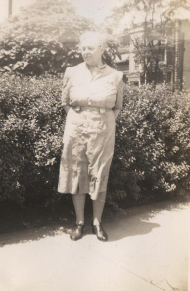
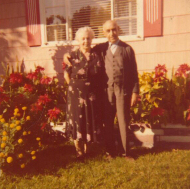
Born: 1887 in Augsburg. Father’s occupation: man of independent means.
Charlotte’s parents were Seligmann (aka Sigmund) Bein (b. 1854) and Rosa, née Sondhelm (1857–1900). They had run a cheese business before Seligmann retired and became a man of independent means. Charlotte was the youngest of four children, her siblings were Babette (b. 1880), Therese (b. 1881) and Max (1884–1961). Seligmann died in 1900.
Charlotte attended the “Municipal School for Daughters” (“Städtische Töchterschule”), which later was to be called “Maria-Theresia-School”, from 1898 to 1901 in classes 1–3. She did not attend the fourth grade, which was the school-leaving class in those times. After Seligmann’s death, the family moved from Augsburg to Nuremberg in 1900/01. Charlotte officially moved to Nuremberg on January 30, 1901.
In Nuremberg, Charlotte’s eldest sister, Babette, married Jakob Schmitt (1868–1927), a merchant from Mannheim, in 1903. They had two sons. The family lived in Bamberg and later emigrated to Palestine.
Therese, the second sister, was also married. She had a son and a daughter. The family lived in Augsburg and later emigrated first to the Netherlands, then to Great Britain.
Charlotte married Bernhard Falk (b. 1884). The couple had a son, Martin. The family lived first in Nuremberg, then in Stuttgart. In the 1930s, they emigrated to the USA. They lived in Pittsburgh, Pennsylvania. After her husband had died in 1958, Charlotte moved to St. Petersburg, Florida.
Charlotte’s brother, Max, became co-owner of the factory “Doll & Cie.” before World War I. The factory produced toy steam engines and -trains. At the end of 1938, Max had to sell the business. His sister Charlotte and her son, Martin, managed to obtain visa for Max and his wife, Erna. When the war was begun in
1939, Max and Erna could flee to the Netherlands just in time, from there they travelled to the USA. Their two daughters had been brought to England by a children’s transport in May 1939. They joined their parents in the USA in 1940.
Charlotte Falk, née Bein, died in St. Petersburg, Florida, in 1979.
(Irene Reti, a granddaughter of Charlotte’s brother, Max, as well as Elizabeth R. Miller, a niece of Charlotte, have added to this brief biography. Irene Reti is an oral historian and founder of the feminist publishing house “HerBooks”, Santa Cruz, California.)
Further reading:
Irene Reti, The Keeper of Memory: A Memoir, Santa Cruz, California, 2001.
 |
|
|
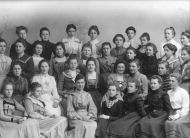
Born: 1886 in Augsburg. Father’s occupation: businessman. Address: 9 / III Prinzregentenstraße.
Klara’s father was Isaak Berberich (b. 1856). Her mother Betty, née Gerstle (1857–1935), was a sister of Hermann Gerstle, the father of Anna Gerstle and grandfather of Käthe and Margot Hirsch.
Klara attended the “Municipal School for Daughters” (“Städtische Töchterschule”), which later was to be called “Maria-Theresia-Schule”, from 1898 to 1902 in classes 1–4 (the 4th class was the school-leaving class in those times).
Klara married Martin Cramer (b. 1880 in Speyer). In 1918, Martin became an office manager of a credit inquiry agency; later, he ran a cigars shop. He played an eminent role in Augsburg’s cultural life. Together with Bert Brecht he founded the “Literary Society”. Klara and Martin had three children: Ernst (b. 1913), Helene (b. 1916) and Erwin (b. 1921).
Hugo Berberich, Klara’s brother (b. 1887), was a doctor in Augsburg. According to the law, he was not allowed to treat “Aryans” after September 30, 1938. He sold his clinic for a ridiculously low price and emigrated to New York with his son and his wife, Eva Maria (“Miez”), née Horn, who was a Christian.
Klara’s two older children were also able to flee to the United States, where Helene died in 1967. Ernst married Marianne Untermayer and returned with her to Germany after the war. As an US soldier, he had spent the days around May 8, 1945, in Augsburg.
In the beginning of April 1942, Klara was deported to Piaski, Poland, at the age of 55, together with her husband, Martin, and her son Erwin; all three are regarded as missing.
For two months, from April to June 1942, the engineer Arnold Hindls from Brno, Moravia, also lived in Piaski. For him this was but one of many deportation
stations, between Terezin and Ossovo. In his memoirs, One Man Returned, published in Germany in 1965, he tells about Piaski: “Piaski is a small town in the Lublin district, surrounded by sand, swamps, and forests. The state road from Lublin to Chelm divides it into two parts. Therefore, the Jewish ghetto, which once was very large and inhabited by approx. 3000 local Jews, extended on both sides of the state road. Now, however, these two parts of the ghetto were each enclosed by high fences made of boards and barbed wire. They had big gates, which were permanently guarded and opened only twice a day, for one hour in the morning and one in the afternoon. The gates were closed towards the state road. ...
The houses of the ghetto were mostly made of wood. They had only small yards and were closely boxed together, mostly built on ground level, only a few had one story. ...The small town had neither plumbing nor sewer. For the approx. 6000 inhabitants of the two parts of the ghetto...there was only one well with acceptable drinking water in the southern part. Each person was allowed to fetch only one ten litre bucket a day from that well. ...
The SS commando which was in charge of the ghetto was stationed in a large, solid building on the outskirts of the southern part of the ghetto, at the state road. The SS could well observe both parts of the ghetto from the balcony of the building. Every visit by those ‘members of the master race’ meant slaps, kicks, and beatings. They confiscated food which was ‘not allowed’ and smuggled into the ghetto. ...Twenty to thirty people, nothing but skin and bones, died of hunger every day. ...
In spite of these catastrophic provision conditions, all men and women who were able to work were recruited into groups to do excavation, gardening, and upkeep of the roads. ...Also within the ghetto, there was enough work to do, for instance, the cleaning and deepening of the drainage and gravel ditches, and the construction of latrines, latrines, and more latrines, of which there were never enough.”
In the autumn of 1942, some Jews were taken from Piaski to Belzec, the others, approx. 4000, were taken to Sobibor, where they were killed. Immediately thereafter, the Piaski ghetto was occupied anew by other deported Jews.
Until the summer of 1942, some letters of the Jews deported to Piaski were received in Augsburg. According to Klara’s son Ernst, there was a rumor that his mother, together with others, had been shot during the transport “as a warning” (letter to Rabbi Ernst Jacob, May 11, 1945).
Klara Cramer’s name (here: Clara Cramer) is listed on a glass plaque of the shoah memorial that can be visited in Augsburg’s City Hall (artist: Klaus Goth).
Sources and further reading:
Irmgard Hirsch-Erlund, Irmgard. Eine jüdische Kindheit in Bayern und eine Vertreibung, ed. Gernot Römer, Augsburg, 1999, pp. 32–36.
Ernst Cramer, Letter of May 11, 1945, printed by Ernst Jacob, Circular No. 10, August 1945, Gernot Römer, ed., “An meine Gemeinde in der Zerstreuung.” Die Rundbriefe des Augsburger Rabbiners Ernst Jacob 1941–1949, Augsburg, 2007, pp. 101–15, at pp. 105–8.
Ernst Cramer, Erfahrungen, Einsichten, Zeugnisse. Beiträge zur deutsch-jüdischen Aussöhnung, Berlin (private publishing Axel Springer Verlag), 1992, esp. pp. 34–37.
Arnold Hindls, Einer kehrte zurück. Bericht eines Deportierten, Stuttgart, 1965, pp. 12–32.
 |
|
|
 |
|
|
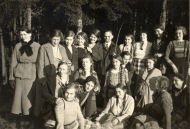
Born: 1920 in Augsburg (no place of birth is given in the Annual School Reports). Father’s occupation: civil engineering entrepreneur.
Gertrud’s parents were Alfred Bernheimer (b. 1877 in Ichenhausen) and Fanny, née Gerngroß (b. 1889 in Nuremberg).
Gertrud attended Maria-Theresia-School from 1930 to 1934 in classes 1–5. On September 4, 1934, the 14-year-old Gertrud left school before the end of the school year and emigrated to the USA together with her parents. Her brother Hermann had already left for the USA one year before; her second brother, Max, followed in 1935.
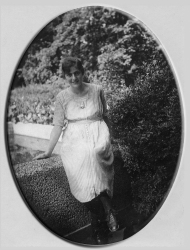
Gertrud married Bert Rabb in 1946. She had two children and numerous grandchildren. Her father, Alfred, died in New York in 1947, her mother, Fanny, in the State of New York in 1981.
Gertrud’s husband, Bert, died in 1985.
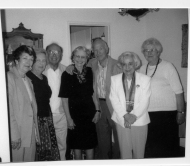
Up to this day, Trudy Rabb still lives in the USA (April 2007).
(Trudy Rabb completed this brief biography herself.)
 |
|
|
 |
 |
|
|
|
Born: 1902 in Charlottenburg (near Berlin). Father’s occupation: practicing GP in Augsburg.
Margarethe’s parents were Dr. Hermann Binswanger (1868–1935) and Karolina, née Rosenbusch.
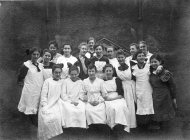
Margarethe attended Maria-Theresia-School from 1913 to 1920 or 1921, at first in classes 1–6 of the “secondary school for girls”, then for another year or two at the “school for women”.
In 1922, Margarethe married the businessman Albert Raff (b. 1896). In the same year, her mother died. Margarethe and Albert Raff got divorced in 1932.
Margarethe married a second time. Her second husband was the lawyer Siegfried Adler (b. 1897 in Haßfurt). In 1936, the married couple emigrated to the USA, where Siegfried worked in the banking profession. He died in 1956 in San Francisco.
Margarethe Adler, née Binswanger, also died in San Francisco in 1988.
Source:
Reinhard Weber, Das Schicksal der jüdischen Rechtsanwälte in Bayern nach 1933, Munich, 2006, p. 220 (on Siegfried Adler).
Born: 1912 in Sterbfritz. Father’s occupation: businessman in Augsburg.
Reta’s father was Jakob Birk (b. 1881 in Sterbfritz), he traded in linen and real estate. Reta’s mother was Ida, née Reiter (b. 1883 in Buttenwiesen). Reta had a younger brother, Siegfried (b. 1913).
Reta attended Maria-Theresia-School from 1924 to 1927 in classes 1–3.
Reta officially moved to Karlsruhe in 1936. Her father travelled to Palestine in 1937, then settled in the USA; her mother emigrated to the USA in 1937. The whole family was expatriated in 1938.
Reta was married to Leon (or Leo) Manasse. The couple as well as Reta’s parents lived in New York City. In 1945, a daughter was born to them.
At the end of 1946, Reta owned a Beauty Salon in 656 West 181 Street that offered perms and coloring.
Reta’s mother, Ida, died in New York City in 1947. Reta’s brother, Siegfried, lived in France at that time.
Leon Manasse died in 1982 in New York.
A woman named Reta Manasse died in 2001 in Maryland. Her birthday, however, is given as June 7, whereas the birthday of the pupil of Maria-Theresia-School was June 3.
Source:
Obituary for Ida Birk, Aufbau 13 (1947), No. 39, September 26, p. 13.
Advertisement of Reta Manasse’s “Heights Beauty Salon”, Aufbau 12 (1946), No. 47, November 22, p. 37, and No. 49, December 6, p. 37.
Born: 1901 in Neuulm. Father’s occupation: livestock dealer.
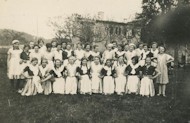
Sophie attended the “Municipal Secondary School for Girls” (“Städtische Höhere Mädchenschule”), which later was to be called “Maria-Theresia-School”, for one year only, in 1912/13 in class 1. Her father had already died before then. The family lived in Kriegshaber (which became a district of Augsburg in 1916).
 |
|
|
Born: 1921 in Augsburg (no place of birth is given in the Annual School Reports). Father’s occupation: businessman. Flat: 14 Frölichstraße.
Margarete’s father, Helmuth Bloch (b. 1893 in Mülhausen), was one of the owners of the wholesale business for textiles “Bach & Bloch”. This factory had been founded as a spinning and weaving mill in Mülhausen / Mulhouse (Alsace), but was reopened in Augsburg after the First World War by the sons of the founders. The other associates were Edmund and Ralph Bach.
Margarete’s mother was Gertrud, née Nathan (b. 1898 in Augsburg). Margarete had a younger sister, Gabriele (b. 1930).
Margarete attended Maria-Theresia-School from 1931 to 1936 in classes 1–3 and G4–G6.
15-year-old Margarete dropped out of the school on December 9, 1936, before the end of the school year. She emigrated to the USA together with her parents. There she married Wilbert Stein and lived with him in California. The couple had two sons. Later they got divorced.
Margot Stein, née Margarete Bloch, died in 2002 in San Francisco.
Born: 1893 in Kriegshaber (near Augsburg). Father’s occupation: goods salesman in Munich.
Selma was an “illegitimate” child of Bertha Bornheim, née Brill (1852–1929). Her mother lived in Steppach (near Augsburg) until she married the American Moses Bornheim. Later, Bertha and Moses got divorced.
Selma attended the “Municipal School for Daughters” (“Städtische Töchterschule”), which later was to be called “Maria-Theresia-School”, from 1905 to 1908 in classes 1–3.
After completing school, Selma worked as a clerk in the suspenders factory “Bernhard Bär”, later (until 1927) as a temporary employee of the City Employment Office.
A woman named Selma Brill died in 1965 in the State of New York. Her birthday, however, is given as February 2, whereas the birthday of the pupil of Maria-Theresia-School was February 7.
Aside:
According to a document preserved at the Augsburg City Archives, Selma’s name was Sarah Brill.
Born: 1917. Father’s occupation: businessman.
Hermine attended Maria-Theresia-School from 1927 to 1933 in classes 1–6.
Hermine emigrated to the USA in 1945 at the latest. She married the staff sergeant Julius Kaufmann from Hilbringen-Merzig. The couple had three children.
Hermine Kaufman, née Brummer, died in Richmond, Virginia, in 1977.